After a long period of inactivity I get to blog about my favorite subject – the LPGA. This time it might be good news, but, as with everything else in the world of Ms. Bivens, we'll just have to wait and see. This time she has created a new position, the CMO (that's Chief Marketing Officer for all of us who are not up on the latest corporate speak), and has selected William F. Susetka to fill the position. (Darn, if I'd only known the position was open.) She made this announcement yesterday, Nov. 29, 2006, on the first day of the Q-School finals, which may give you some idea as to why she needs some marketing assistance. Trying to snatch away the spotlight from the players during a crucial event does not seems like a particularly great marketing move. The players are the product and you don't upstage them in any way. Susetka will not assume the position until Jan. 2, 2007 so the announcement could have waited a few days.
Susetka has outstanding credentials, at least as far as the ladies are concerned: Most recently, Susetka served as chief operating officer of Nice-Pak Products (2005-06). Prior to that, he was president of Global Marketing for Avon Products Inc. (2002-05), where he led double-digit beauty growth for three years and introduced the most successful new product launches for skin care and fragrance in Avon history with Anew Clinical, Cellu-Sculpt and the Today, Tomorrow, Always fragrance trilogy. Well, at least the ladies will smell nice. And I would appreciate some feedback on the meaning of double-digit beauty growth. No, wait, let me guess. This means that there are now twice as many beautiful women in the world as there were in 2002.
And one of Susetka's responsibilities will be to oversee emerging media departments. We can only assume that this means the Internet unless we're talking about satellite transmissions to another galaxy. And with the Internet comes bloggers. Maybe, perhaps, hopefully, this guy will get the picture and allow faithful bloggers into the Media Tent. He just might open up a whole new world of positive feedback for the LPGA.
Thursday, November 30, 2006


Monday, November 06, 2006
Old Works will stretch your game but not your budget
The word “unique” is frequently employed as a descriptive term for golf courses that are thought to possess one of a kind settings and layouts. Truth is any course which deviates slightly from the traditional or the accepted is given the unique moniker. It becomes difficult to designate well-deserved courses as special in regard to setting and design. Discretion in labeling golf courses is crucial. Every golf course designed and constructed cannot be extra special. On the other hand it is important not to overlook those that are obviously in the one-of-a-kind category. Such is the case for Old Works Golf Course in Anaconda, Montana.
There has been no shortage of acclaim for the Jack Nicklaus design which opened in 1996 and has consistently been included on every Top 100 Public Golf Course list. GolfWeek selects it as the best in the entire state. Golf Digest places Old Works at number 82 on its list of America's 100 Greatest Public Courses. These lofty evaluations are not mistakes or overestimations. Old Works lives up to its accolades and to our high expectations with an extremely interesting layout, excellent course conditions, friendly staff and the best darn price.
Carved throughout an abandoned copper mine, Nicklaus has truly created a work of art. And it is the copper mine that provides the fascination and the ambiance of the layout. Visions of its former existence are virtually everywhere beginning at the first tee box with the display of two huge smelters which have been turned into planters. The par 5 third and the par 3 fourth play parallel to the deteriorating stone furnaces. And the “sand” in the bunkers is not really sand at all; rather it's black slag.
 First tee at Old Works
Old Works contains a first-rate practice facility that includes a range, putting green and practice green for chipping and bunker play. These are all conveniently located near the first tee. Nicklaus has also incorporated a very practical warm-up feature, a three hole course that circles the practice range. It gives you the opportunity to get a feel for the lay of the land, the greens and the bunkers.
With five sets of tee boxes appropriately dubbed Slag, Gold, Copper, Limestone and Brick, Old Works allows every golfer to play the course at a length which is comfortable yet challenging. Each tee is appropriated with the properly coordinated color tee markers. The Slag plays the longest at 7705 yards and the Brick the shortest at 5348 yards. While that may appear to be a bit lengthy, don't forget to allow for the elevation of Anaconda, almost a mile above sea level. The elevation and the fact that several holes play from elevated tee boxes make the course playable for everyone. The front nine has dramatic elevation changes as the course climbs and descends and twists and turns around the remaining mounds and hills of the old copper mine. From the fourth tee, the highest point on the golf course, you can overlook the entire front nine and a couple of holes on the back. The view is striking and gives a good perspective on what Nicklaus has done with the property. The back nine is relatively flat and has a totally different feel from the front. Approach shots on the par 4 tenth and the par 5 eleventh require a carry over a meandering creek that runs along the right side of #10 and the left side of #11. These are the only holes on the course which require a forced carry. Every other hole offers an opening to the green.
The course makes minimal demands from the tee presenting wide fairways that stretch out even wider in the landing areas. Hitting the fairways from the beautifully maintained tee boxes (We've played on some greens that were not as well groomed.) is not the dilemma. The difficulty of the course comes on the approach shots to the extra large, undulating greens that usually putt to a speed of 10 or 11 on the stimpmeter. Despite the wide fairways, it is critical to position the tee shot properly to allow for the best angle of approach into the greens. Misplaced tee shots will set up approach shots that must carry bunkers or present odd angles to the greens. This combination make the course fair yet at the same time challenging.
The front nine contains several interesting holes. The par 5 third is an uphill do gleg right that tempts you to cut the corner on your second shot. The approach shot is to a two level green with the lower part in the back. The hole also plays along the remains of the old brick furnaces. The fourth is par 3 that plays slightly uphill with more mine remnants in the background. The most fascinating and spectacular hole on the front nine is the par 3 seventh which plays to a maximum of 238 yards. But the yardage is deceiving. The tee box sits atop of what seems like a small mountain of slag and the hole plays about fifty feet downhill across a huge bunker of the signature black slag sand. The mountains in the distance also provide a nice backdrop for the hole.
We found the tenth and eleventh to be best holes on the back. Number ten is a par four that curves slightly to the right with the creek along the right and then cutting in front of the green. The fairway appears narrow from the tee, but the landing area is generous as with all the other holes. The hole plays a little longer than the given yardage and the approach shot is very intimidating. It will make you play long or right to avoid the creek. The par 5 eleventh entices you to hit it long for two shots. At that point the fairway turns to the left and you must thread your approach through an opening in the trees and over the same creek you just negotiated at number 10. The fairway is wide but the approach must be precise to the very shallow green. The most difficult holes on the course is number sixteen. It's a long, uphill par 4 that usually plays into the wind. There's a lake on the right that shouldn't come into play, but is quite visible from the tee.
Old Works is a must play. The quality and the “unique” setting of the golf course, the friendliness of the staff, and the downright bargain price (always less than $50) make this a definite stop. And while Anaconda, Montana might not be the ultimate golf resort destination, it does have two other golf courses to offer: Anaconda Country Club and Fairmont Hot Springs Golf Course. It's a small town with a big golf feel.
There has been no shortage of acclaim for the Jack Nicklaus design which opened in 1996 and has consistently been included on every Top 100 Public Golf Course list. GolfWeek selects it as the best in the entire state. Golf Digest places Old Works at number 82 on its list of America's 100 Greatest Public Courses. These lofty evaluations are not mistakes or overestimations. Old Works lives up to its accolades and to our high expectations with an extremely interesting layout, excellent course conditions, friendly staff and the best darn price.
Carved throughout an abandoned copper mine, Nicklaus has truly created a work of art. And it is the copper mine that provides the fascination and the ambiance of the layout. Visions of its former existence are virtually everywhere beginning at the first tee box with the display of two huge smelters which have been turned into planters. The par 5 third and the par 3 fourth play parallel to the deteriorating stone furnaces. And the “sand” in the bunkers is not really sand at all; rather it's black slag.
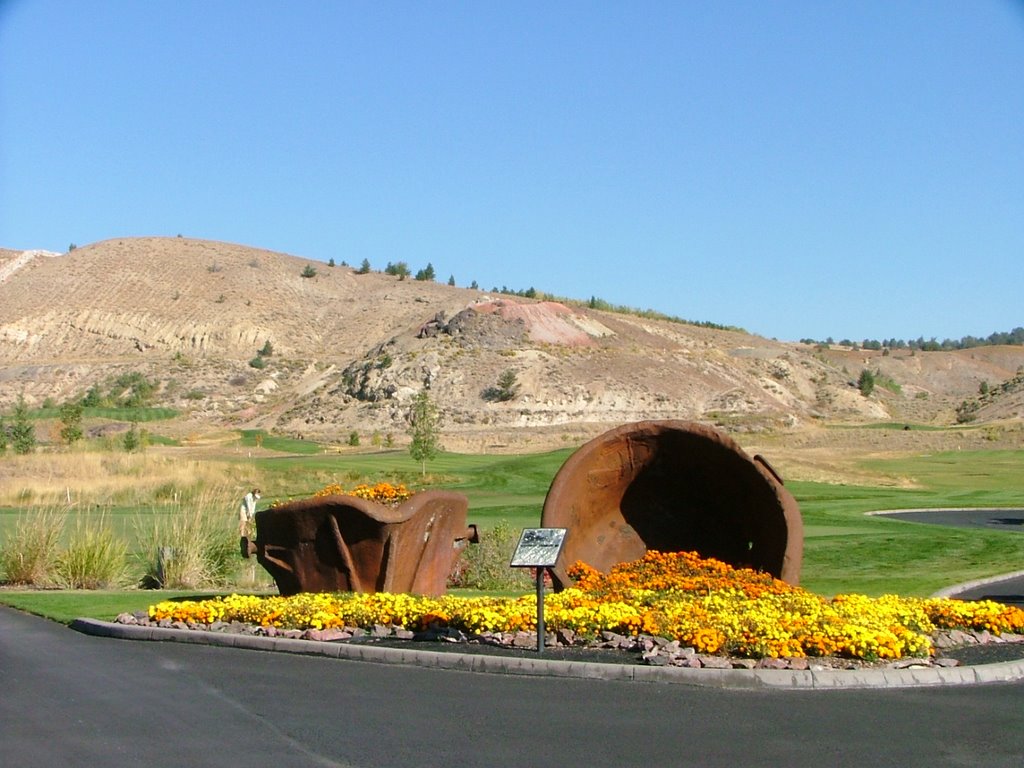 First tee at Old Works
Old Works contains a first-rate practice facility that includes a range, putting green and practice green for chipping and bunker play. These are all conveniently located near the first tee. Nicklaus has also incorporated a very practical warm-up feature, a three hole course that circles the practice range. It gives you the opportunity to get a feel for the lay of the land, the greens and the bunkers.
With five sets of tee boxes appropriately dubbed Slag, Gold, Copper, Limestone and Brick, Old Works allows every golfer to play the course at a length which is comfortable yet challenging. Each tee is appropriated with the properly coordinated color tee markers. The Slag plays the longest at 7705 yards and the Brick the shortest at 5348 yards. While that may appear to be a bit lengthy, don't forget to allow for the elevation of Anaconda, almost a mile above sea level. The elevation and the fact that several holes play from elevated tee boxes make the course playable for everyone. The front nine has dramatic elevation changes as the course climbs and descends and twists and turns around the remaining mounds and hills of the old copper mine. From the fourth tee, the highest point on the golf course, you can overlook the entire front nine and a couple of holes on the back. The view is striking and gives a good perspective on what Nicklaus has done with the property. The back nine is relatively flat and has a totally different feel from the front. Approach shots on the par 4 tenth and the par 5 eleventh require a carry over a meandering creek that runs along the right side of #10 and the left side of #11. These are the only holes on the course which require a forced carry. Every other hole offers an opening to the green.
The course makes minimal demands from the tee presenting wide fairways that stretch out even wider in the landing areas. Hitting the fairways from the beautifully maintained tee boxes (We've played on some greens that were not as well groomed.) is not the dilemma. The difficulty of the course comes on the approach shots to the extra large, undulating greens that usually putt to a speed of 10 or 11 on the stimpmeter. Despite the wide fairways, it is critical to position the tee shot properly to allow for the best angle of approach into the greens. Misplaced tee shots will set up approach shots that must carry bunkers or present odd angles to the greens. This combination make the course fair yet at the same time challenging.
The front nine contains several interesting holes. The par 5 third is an uphill do
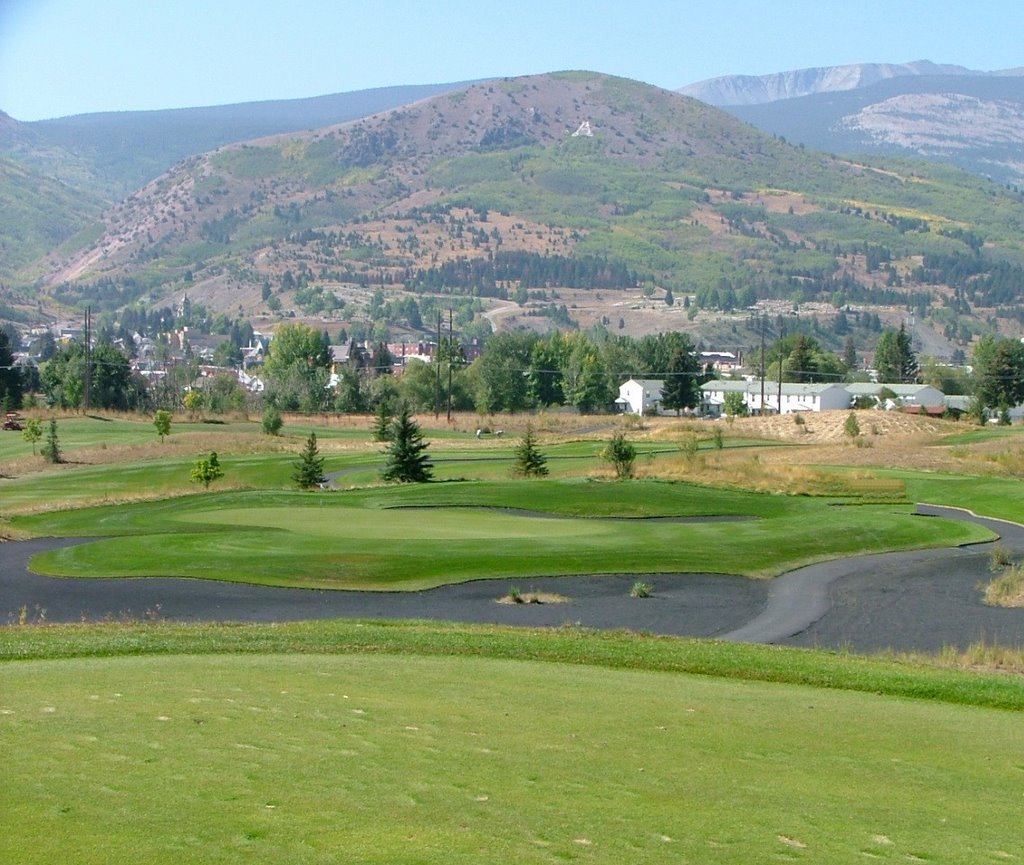 gleg right that tempts you to cut the corner on your second shot. The approach shot is to a two level green with the lower part in the back. The hole also plays along the remains of the old brick furnaces. The fourth is par 3 that plays slightly uphill with more mine remnants in the background. The most fascinating and spectacular hole on the front nine is the par 3 seventh which plays to a maximum of 238 yards. But the yardage is deceiving. The tee box sits atop of what seems like a small mountain of slag and the hole plays about fifty feet downhill across a huge bunker of the signature black slag sand. The mountains in the distance also provide a nice backdrop for the hole.
We found the tenth and eleventh to be best holes on the back. Number ten is a par four that curves slightly to the right with the creek along the right and then cutting in front of the green. The fairway appears narrow from the tee, but the landing area is generous as with all the other holes. The hole plays a little longer than the given yardage and the approach shot is very intimidating. It will make you play long or right to avoid the creek. The par 5 eleventh entices you to hit it long for two shots. At that point the fairway turns to the left and you must thread your approach through an opening in the trees and over the same creek you just negotiated at number 10. The fairway is wide but the approach must be precise to the very shallow green. The most difficult holes on the course is number sixteen. It's a long, uphill par 4 that usually plays into the wind. There's a lake on the right that shouldn't come into play, but is quite visible from the tee.
Old Works is a must play. The quality and the “unique” setting of the golf course, the friendliness of the staff, and the downright bargain price (always less than $50) make this a definite stop. And while Anaconda, Montana might not be the ultimate golf resort destination, it does have two other golf courses to offer: Anaconda Country Club and Fairmont Hot Springs Golf Course. It's a small town with a big golf feel.
Tuesday, April 11, 2006
Masters Reflections
Picking the Winner: Well, you can see we came real close. (Just refer back to our previous entry.) At least we did mention Phil’s name.
Big Losers or Major Disappointments or When the Heck are these guys going to produce:
Mike Weir – we’re still waiting for him to do something again. He always seems to be close for the last 36 holes but can never seem to reproduce the magic that brought him that green jacket. Shame.
Darren Clarke – Clarke starts the final round just two shots back and all of us at the pub are pulling for the jolly Irishman. So how does he reward us? A birdie on the first to really get our hearts pumping and the Guinness flowing! Then, a lackluster 77 with seven bogies the rest of the way.
Ernie Els/Retief Goosen – Close, both had a chance – AGAIN! Maybe these guys need to be told that this is a major championship. At least they could show a little interest.
“The Young Guns” – Another major tournament where the young studs so heavily promoted by the PGA Tour and the media fail to produce. These kids had better get with it before a great golf career passes them by.
Summation: A good tournament, not a great one. Too many guys, i.e., all but one, failed to come up with something special in the final round.
Big Losers or Major Disappointments or When the Heck are these guys going to produce:
Mike Weir – we’re still waiting for him to do something again. He always seems to be close for the last 36 holes but can never seem to reproduce the magic that brought him that green jacket. Shame.
Darren Clarke – Clarke starts the final round just two shots back and all of us at the pub are pulling for the jolly Irishman. So how does he reward us? A birdie on the first to really get our hearts pumping and the Guinness flowing! Then, a lackluster 77 with seven bogies the rest of the way.
Ernie Els/Retief Goosen – Close, both had a chance – AGAIN! Maybe these guys need to be told that this is a major championship. At least they could show a little interest.
“The Young Guns” – Another major tournament where the young studs so heavily promoted by the PGA Tour and the media fail to produce. These kids had better get with it before a great golf career passes them by.
Summation: A good tournament, not a great one. Too many guys, i.e., all but one, failed to come up with something special in the final round.
Wednesday, April 05, 2006
A Masters Victory
Attempting to pick the winner of a golf tournament is similar to strapping on a pair of skis for the first time and heading down the XXX Olympic ski slope in Seefeld, Austria. It’s foolish and it’s dangerous. Although is has to be easier in the Masters because the field is smaller. So, what the heck, we’ll give it a go. This list is so scientific that it was rejected by all the leading golf publications. If you’ve got a lot of extra green, here’s our list of can’t miss bets:
Someone you can bet on with a good chance of making a little dough:
Tiger Woods – Why would you not put down a minimal wager?
Retief Goosen – If we could only get “Goose” to show a little more interest, we might increase the wager.
No chance:
Phil Mickelson - because he played too damn good last week.
Sentimental Favorites:
John Daly - It would be great to have burgers and beer for the 2007 Champions Dinner.
Tom Lehman – He’s been playing decent and he looks Ryder Cup captainish with that long putter.
The O.F. Emotional Favorite:
Ben Crenshaw – Hey, it could happen. History has a tendency to repeat itself.
The Real Winner:
Someone you would never dare to put $1000 on.
That’s all. We can’t pick everybody in the field.
Someone you can bet on with a good chance of making a little dough:
Tiger Woods – Why would you not put down a minimal wager?
Retief Goosen – If we could only get “Goose” to show a little more interest, we might increase the wager.
No chance:
Phil Mickelson - because he played too damn good last week.
Sentimental Favorites:
John Daly - It would be great to have burgers and beer for the 2007 Champions Dinner.
Tom Lehman – He’s been playing decent and he looks Ryder Cup captainish with that long putter.
The O.F. Emotional Favorite:
Ben Crenshaw – Hey, it could happen. History has a tendency to repeat itself.
The Real Winner:
Someone you would never dare to put $1000 on.
That’s all. We can’t pick everybody in the field.
Monday, April 03, 2006
Too Chip or Putt?
Whoever is instructing Michelle Wie on the chipping and putting aspect of the game should also work with her a little more on how to think around the green. A poor thought process on the 72nd green of the Kraft Nabisco Championship may have cost her her first major title. Wie needed a birdie on the par-5 18th to tie Karrie Webb. A driver and a 5-iron put her 25 feet away just over the green with about five feet of fringe to clear. Wie elected to chip the ball and juiced it a bit. It ran about ten feet past. She made a good putt at the birdie that would have tied but it missed.
Somewhere along the line someone has taught her that if you want to sink it, chip it. Perhaps that’s true, perhaps not. That’s another discussion. What’s at fault here is her thinking process. Someone has failed to teach her how to think the situation through completely. She did not need to sink it “at all costs.” Yes, it might have been the ultimate in drama had she sunk the chip, but that’s not what she needed at this point. She needed a sure four with a chance at a possible three. She needed to play the shot that gave her the highest percentage to accomplish that. Using the putter to get down in two from 25 feet was not a difficult task. Two putts give her a tie and, if she gets a little lucky, the ball goes in and she wins. By using the putter she would have almost certainly have put herself in the playoff which started on the same 18th hole where she would have had a definitive advantage.
But that’s what makes major champions: smart decisions and the proper time.
Somewhere along the line someone has taught her that if you want to sink it, chip it. Perhaps that’s true, perhaps not. That’s another discussion. What’s at fault here is her thinking process. Someone has failed to teach her how to think the situation through completely. She did not need to sink it “at all costs.” Yes, it might have been the ultimate in drama had she sunk the chip, but that’s not what she needed at this point. She needed a sure four with a chance at a possible three. She needed to play the shot that gave her the highest percentage to accomplish that. Using the putter to get down in two from 25 feet was not a difficult task. Two putts give her a tie and, if she gets a little lucky, the ball goes in and she wins. By using the putter she would have almost certainly have put herself in the playoff which started on the same 18th hole where she would have had a definitive advantage.
But that’s what makes major champions: smart decisions and the proper time.
Thursday, March 30, 2006
A Fifth Major?
Should the Tournament Players’ Championship be considered a major championship and thus raise the quantity of majors from four to five? This question arises every year and is debated everywhere in the golf world ad nauseam, ad infinitum, ad boredom. It’s no secret that Tim Finchem is trying his hardest, subtly or brazenly, to get the golf world to accept the TPC as a major. The answer to any golf traditionalist or purist is, of course, a resounding, “No!”
The most basic reason is that the math doesn’t work. The “Grand Slam” is based on the number four. It’s a baseball term with the number four at its core. A player hits one out of the park with the bases loaded and four runs score, he gets four RBI’s, he touches four bases and he makes four more million dollars. Everything is FOUR! If a fifth major comes about, no longer can we use the term “Grand Slam.” We have to use something with a connotation of five. Perhaps we could use “The Great Quinary.” Somehow that doesn’t seem to have the same quality as “Grand Slam.” Maybe we could borrow “The Mighty Quinn?” I think this would be good, then, if someone in his 50’s wins all five major championships, the media would have a linguistic Mardi Gras. The winner would be known as “The Mighty Quinquagenarian Quinn.” And further verbal possibilities are endless.
So you see how silly this whole idea is? In its elementary form it doesn’t work. In its corporate form it’s an avaricious, self-indulgent maneuver.
This year, in his continuing effort to force his will upon the golf world, Tim Finchem is employing that tried, tested and failed corporate strategy of “throw more money at it.” Before the ink dries on Stephen Ames’ check, bulldozers will be leveling the clubhouse and contouring the fairways. That’s right, a new clubhouse, better drainage in the fairways, and a pumped-in air duct system under the greens is all part of a plan to make the TPC more ornate and glamorous with perfect course conditions. All this for a cool $22-$28 million. If you can try to buy a game in the world of golf by spending an obscene amount of money on equipment, why not try to buy a major by spending an obscene amount of money on “upgrading” a golf facility that is already well-suited for the purpose. Why not cut back on a couple of new $500,000 columns on the clubhouse and employ that money to rebuild a few houses in the gulf coast states? That would be a major.
The most basic reason is that the math doesn’t work. The “Grand Slam” is based on the number four. It’s a baseball term with the number four at its core. A player hits one out of the park with the bases loaded and four runs score, he gets four RBI’s, he touches four bases and he makes four more million dollars. Everything is FOUR! If a fifth major comes about, no longer can we use the term “Grand Slam.” We have to use something with a connotation of five. Perhaps we could use “The Great Quinary.” Somehow that doesn’t seem to have the same quality as “Grand Slam.” Maybe we could borrow “The Mighty Quinn?” I think this would be good, then, if someone in his 50’s wins all five major championships, the media would have a linguistic Mardi Gras. The winner would be known as “The Mighty Quinquagenarian Quinn.” And further verbal possibilities are endless.
So you see how silly this whole idea is? In its elementary form it doesn’t work. In its corporate form it’s an avaricious, self-indulgent maneuver.
This year, in his continuing effort to force his will upon the golf world, Tim Finchem is employing that tried, tested and failed corporate strategy of “throw more money at it.” Before the ink dries on Stephen Ames’ check, bulldozers will be leveling the clubhouse and contouring the fairways. That’s right, a new clubhouse, better drainage in the fairways, and a pumped-in air duct system under the greens is all part of a plan to make the TPC more ornate and glamorous with perfect course conditions. All this for a cool $22-$28 million. If you can try to buy a game in the world of golf by spending an obscene amount of money on equipment, why not try to buy a major by spending an obscene amount of money on “upgrading” a golf facility that is already well-suited for the purpose. Why not cut back on a couple of new $500,000 columns on the clubhouse and employ that money to rebuild a few houses in the gulf coast states? That would be a major.
Tuesday, March 28, 2006
These Guys Are Good?
Perhaps it may be time for the PGA Tour to alter its catch phrase just a touch. After watching the devastation over the weekend at the TPC, the new phrase could be, “This Guy Is Good.” Yes, I know the TPC is a most difficult golf course and it was set up to devour the world’s best golfers. Or we could take the more positive approach and say that it was set up to challenge the world’s best. In that case only one met the challenge – Stephen Ames. When the pressure was on playing a man-eating the gentlemen of the PGA Tour were hitting horrible golf shots and making poor course management decisions.
What a for instance? Let’s see, two-time champion Davis Love missed the cut by playing like the best golfer in the world on Thursday and then like the third member of your regular Saturday foursome on Friday capping it all of with a 9 on his final hole. I don’t care how you shake it, if you make a nine on a par-5, there’s some bad golf going on. Over the weekend 2004 champion Adam Scott shot 82-76. Had to be an ugly swing or two in there somewhere. On Sunday, Phil Mickelson is 200 yards from the hole on the par-5 16th. So, what’s that for Lefty, a 5-iron? You’d figure with that club in his hands it’s at least in the middle of the green with a 30-footer for eagle. Oh, no, it wound up some 40 yards left of the green and he struggled to make par.
You want more? Buy the tape from Tim Finchem. It’ll be called “These Guys Are (Ooops)!”
What a for instance? Let’s see, two-time champion Davis Love missed the cut by playing like the best golfer in the world on Thursday and then like the third member of your regular Saturday foursome on Friday capping it all of with a 9 on his final hole. I don’t care how you shake it, if you make a nine on a par-5, there’s some bad golf going on. Over the weekend 2004 champion Adam Scott shot 82-76. Had to be an ugly swing or two in there somewhere. On Sunday, Phil Mickelson is 200 yards from the hole on the par-5 16th. So, what’s that for Lefty, a 5-iron? You’d figure with that club in his hands it’s at least in the middle of the green with a 30-footer for eagle. Oh, no, it wound up some 40 yards left of the green and he struggled to make par.
You want more? Buy the tape from Tim Finchem. It’ll be called “These Guys Are (Ooops)!”
Subscribe to:
Posts (Atom)